
London’s political map is about to be redrawn

Emily Clinton
Insight Lead
12 February 2026
With 12 weeks to go until Londoners head to the polls, we are gearing up for what look certain to be the most significant local elections for 20 years. On 7 May, all 1,817 councillors in all 32 London boroughs are up for election and the current state of the polls means that these elections are harder to predict than ever before.
Widespread disapproval of the Labour government is clear in the national polls. POLITICO’s Poll of Polls best illustrates Labour’s fall from grace, from winning the General Election with 34% of the vote, to polling around the 19% mark and in the past few months, even coming in third place behind Reform UK and the Conservatives in some polls. The events of the past few days haven’t exactly endeared the public to the Prime Minister either, with 48% of people saying that Keir Starmer should resign.
Drilling down into the London data tells a slightly different story. The capital is actually the only place in the country where Labour is polling in first place (albeit only just), recently being described as the party’s ‘last bastion’ by The Economist. However, comparing their current place in the polls to their position at the General Election paints a better picture – the party’s popularity is falling here too. In July 2024, Labour was achieving 43% in the polls. This has now dropped to 31%, a record low for the party in the capital.
So, which parties are benefitting from this shift? Traditionally, in our two-party system, voters would have made a direct swap to the Conservatives, but this is no longer the case in what legendary political commentator Professor Sir John Curtice calls a five-party system, in which several political parties are benefitting from Labour’s demise.
While many Londoners might assume that the capital would be immune to the popularity of Reform seen elsewhere in the country, that isn’t necessarily the case, with Savanta’s January poll putting the party in second place in the capital on 19% of the vote. Nigel Farage’s party has been open about their targeting of those Outer London Brexit-voting boroughs – think Bexley and Bromley – at the elections. What’s more, Reform councillors are likely to be elected across London (although most likely to be in the outer ring of the capital), but could we even see Reform take control of a borough? In these political times, nothing is impossible.
The Greens, under the new leadership of Zack Polanski (a Londoner himself who has been on the London Assembly since 2021) are going from strength to strength and even polled in first place in the capital back in early December. The party’s popularity amongst younger voters (18-24 year olds) will certainly place them in good stead in the capital, as well as in other cities across the country. Like Reform, the Greens have also been open about the boroughs they are targeting. The mayoralty in Hackney is one of their top targets, but we are likely to see swathes of Green councillors elected across the capital as the progressive alternative to Labour. Recent by-election results in London have indicated that the Greens are increasingly becoming the refuge for those on the left in the capital disillusioned by the Labour Government. With just 18 Green councillors elected in the capital last time around, we can expect that number to grow exponentially in May – and perhaps more than 18 elected in a single borough.
Previously the refuge for disgruntled left leaning voters in the capital, the Lib Dems will be desperate to carve out some space in this busy political landscape, where voters now have several ways to express their discontent with the two main parties. Polling consistently in the low teens in London, the party will be seeking to build on their South West stronghold. With there unlikely to be any change in Richmond or Kingston, might they be looking at next door Merton following their win in the Wimbledon constituency at the 2024 General Election?
As for the Conservatives, while their fortunes might be improving slightly nationally, the same can’t be said for London. Currently languishing around the 16% mark in the polls, the party is struggling to make any cut through in an increasingly crowded political scene, firmly behind Labour and the Greens in the capital. Their aim this time around will be to cling on to the boroughs they currently control, though a nationally unpopular Labour party might mean that they will be hoping to regain their flagship boroughs – Westminster, Wandsworth and Barnet – which were lost to Labour last time around. In normal times, we’d expect the pendulum to swing back their way, leaving these three boroughs very vulnerable to returning to the Tories. However, with the current polls, that is not necessarily a given.
Away from the established parties, it is worth considering the impact of independent candidates. Having caused quite a stir in a few constituencies at the General Election (campaigning primarily on events in the Middle East), some independent movements in the capital have now professionalised and formed organised groups within some boroughs. Whether campaigning on hyper-local or international issues, we are likely to see more independent candidates elected across the capital, which could prevent other parties from winning majorities.
So, what does this all mean? Labour’s dominance of the capital is under threat from all angles and the splintering of the vote means that we are likely to see many knife edge results, shrunken majorities and more No Overall Control (NOC) boroughs, where no one party has a majority. London’s political scene looks like changing dramatically – bringing new leadership, uncertainty and new challenges for the built environment.
For support navigating these politically uncertain times, get in touch with LCA’s Insight Team using insight@thisislca.com.
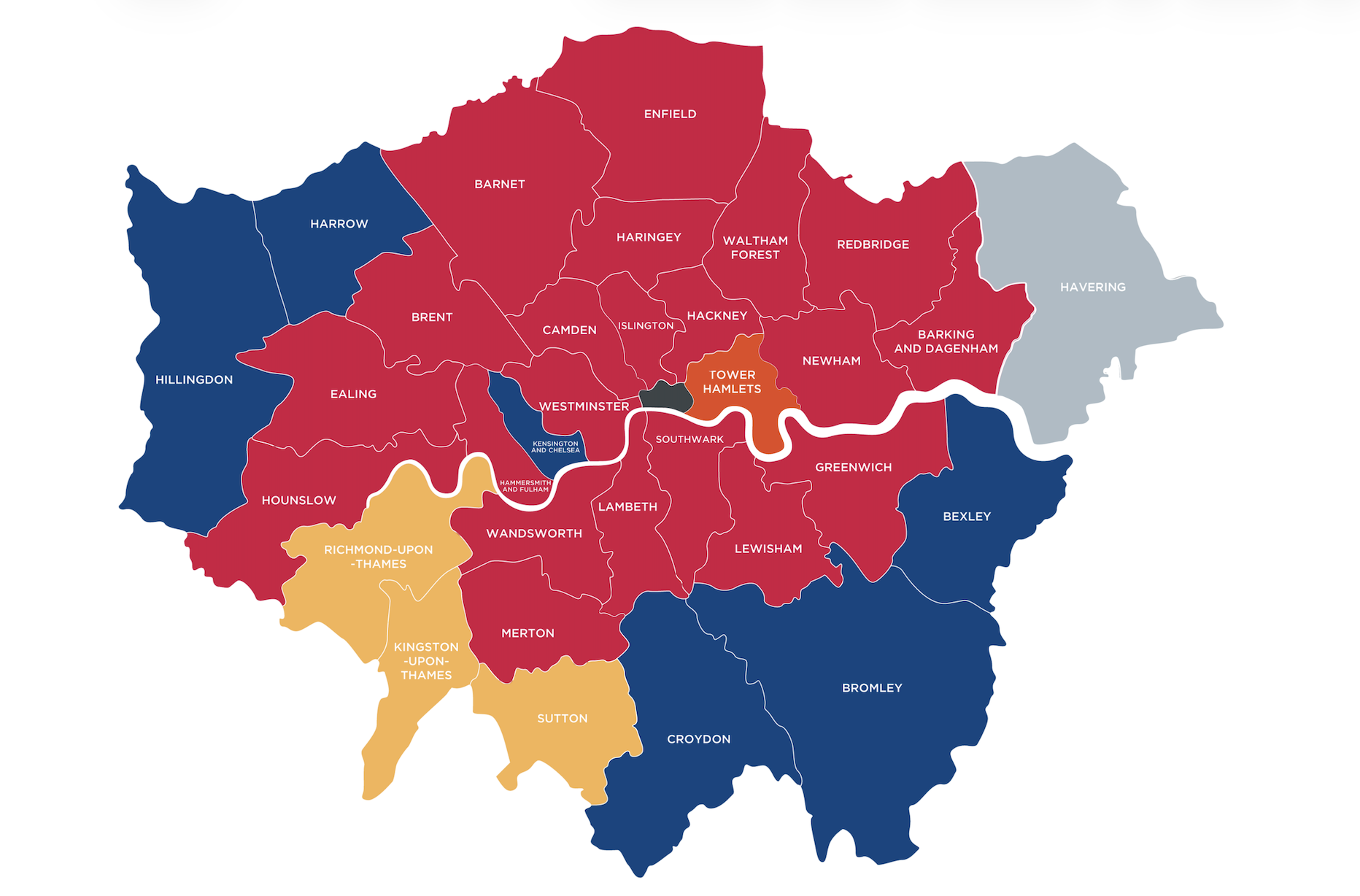
London’s political map, as it stands (2022 election results)
